Namibia
Overview
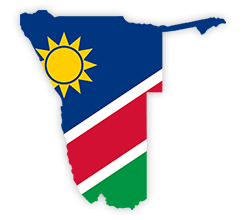
Namibia, a large and sparsely populated country on Africa's south-west coast, has enjoyed stability since gaining independence in 1990 after a long struggle against rule by South Africa. Namibia achieved independence in 1990 after a bush war of almost 25 years. Inter-racial reconciliation encouraged the country's white people to remain and they still play a major role in farming and other economic sectors.
Deserts occupy much of the country; their dunes take on shapes and colours according to the elements. The country also boasts game-rich grasslands and a semi-arid Central Plateau, large tracts of which are given over to livestock farming.
Economic Indicators 20241
| Capital City | Windhoek |
| Country size | 825 615 km2 |
| GDP at current prices (2024) | R245.1 billion |
| Population (2025) | 3,022,401 |
| Independence Day | 21 March |
| Website | www.gov.na |
| GDP per capita | R91,194 |
| Real economic growth rate (2024) | 3.7% |
| Annual inflation rate (2025) | 3.5% |
| Merchandise imports (intra-SACU Trade) (2024) | R60.3 billion |
| Merchandise exports (intra-SACU Trade) (2024) | R40.6 billion |
| Imports to the Rest of the World (2024) | R162.7 billion |
| Exports to the Rest of the World (2024) | R119.9 billion |
1 The Source of data for Real GDP growth and Inflation are Member States Economic Background Papers submitted in May 2024, to support the calculation of the 2024/25FY Revenue Shares. GDP per capita is a result of the Secretariat calculations (i.e., GDP per capita =GDP/Popn)
Economic Performance 2024
- In 2023, Namibian’s economy grew by 4.4 percent-a deceleration from the 5.4 percent expansion recorded in 2022. This performance was primarily attributable to slower growth in both the primary and secondary industries. During 2023/34, the central bank maintained a relatively tight monetary policy stance to anchor inflation expectations, while fiscal policy remained accommodative to support growth. The annual inflation rate was recorded at 5.9 percent, a slight decrease from the 6.1 percent observed in 2022 primarily driven by significant price increases in the food and non-alcoholic beverages category.
- The economy is projected to grow by 3.7 percent in 2024 based and is projected to grow further by 4.5 percent on average over the MTEF period - growth which is expected to remain broad-based albeit sluggish due to a depressed diamond sector.

